STAGE I – 2023
Fundamental Research Activities – Part I
Act. 1.1. Literature studies on:
- the molecular, supramolecular structure and surface morphology of materials (NMR, XRD, single-crystal analysis, etc.)
- in vitro Electron Spin Resonance (ESR) and the antioxidant capacity of biocompatible compounds
- molecular simulation and modelling of free radicals
- gas capture
- establishing protocols for obtaining single crystals
STAGE II – 2024
Fundamental Research Activities – Part II
Act. 2.1. Fundamental research activities:
- studies on the molecular and supramolecular structure and surface morphology of materials (NMR, XRD, single-crystal analysis, etc.)
- in vitro Electron Spin Resonance (ESR) studies and antioxidant capacity assessment of biocompatible compounds
- studies of molecular simulation and modelling of free radicals
- gas capture studies
- establishing protocols for obtaining single crystals
Act 2.2. Procurement activities for the development of the research infrastructure
Act 2.3. Dissemination of scientific results:
- presentation of the results at international and national conferences
- participation in networking meetings with potential collaborators and/or short-term (1–3 weeks) or long-term (≥1 month) research stays
- project webpage
The studies carried out during this implementation period focused on obtaining supramolecular hydrogels based on G-quartet units, by integrating β-cyclodextrin and 1,4-phenylene diboronic acid into a supramolecular matrix to enhance antibacterial activity. By varying the number of free boronic acid groups and adjusting the guanosine content, both the antimicrobial efficacy and the structural properties of the hydrogels were optimized. Another research direction focused on developing new types of cryogels based on poly(vinyl alcohol) and dextran synthesized by lactic acid bacteria, cryogels with potential adsorption and controlled release properties for active substances in various environments (Fig. 1).
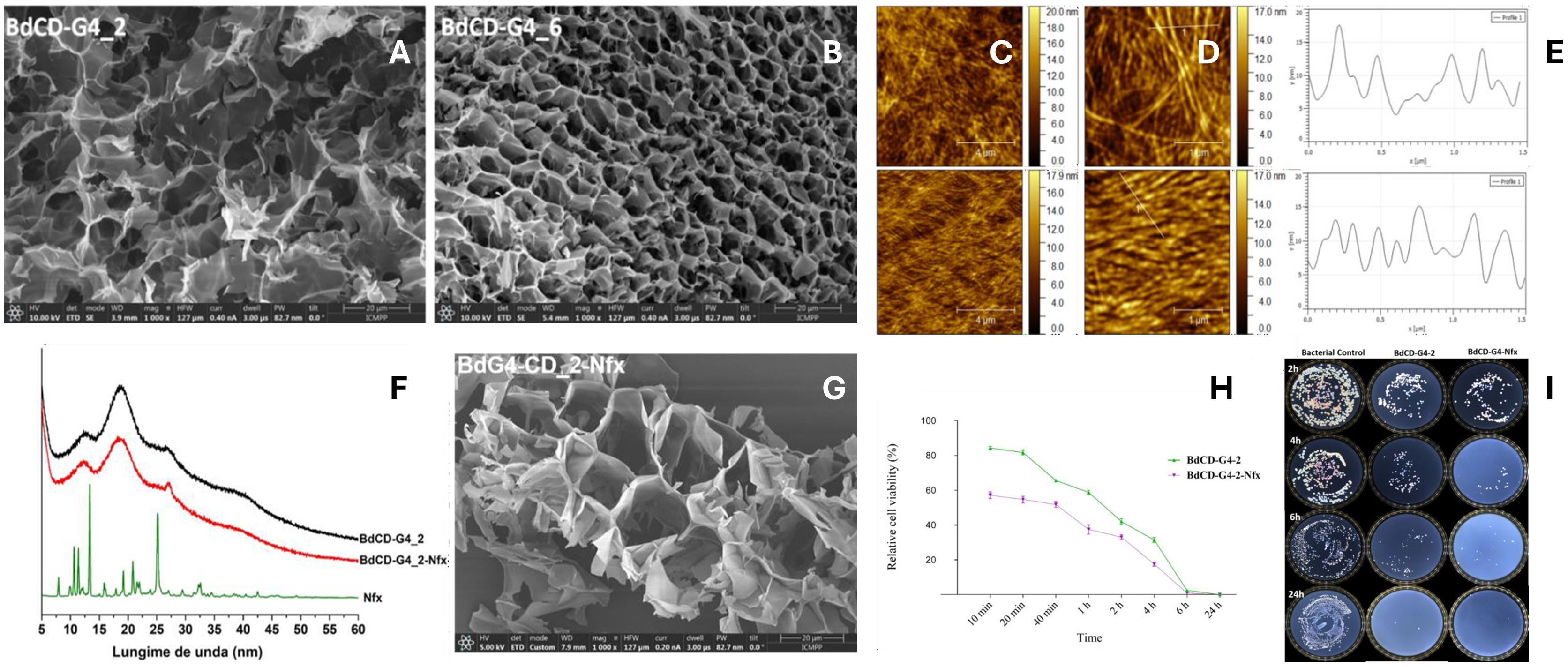
Fig. 1. Representative SEM images of xerogels (A) BdCD-G4_2 and (B) BdCD-G4_6 at a scale of 20 µm. AFM images of hydrogels: (C) scale bar – 4 µm; (D) scale bar – 1 µm; (E) Z-profiles along the marked lines. (F) PXRD patterns of lyophilized norfloxacin (Nfx), xerogel BdCD-G4_2, and BdCD-G4_2-Nfx formulation. (G) SEM image of formulation BdCD-G4_2-Nfx at 20 µm. (H) Inhibition of bacterial colony growth expressed as viable cell percentage vs. incubation time; (I) S. aureus colonies after 2–24 h incubation with the synthesized hydrogels.
In parallel, two types of micelles based on poly(L-histidine) and poly(ethylene glycol) were synthesized and loaded with doxorubicin/trastuzumab, designed as targeted drug delivery systems for tumor cells (Fig. 2).

Fig. 2. (a) Schematic representation of the pHis-PEG polymer sequence and its self-assembly into micellar structures capable of encapsulating non-polar fluorescent model molecules.
(b) Assembly of rhodamine-B- and maleimide-functionalized copolymers into micelles, followed by covalent attachment of thiolated trastuzumab to the micelle surface.
To evaluate antioxidant capacity, ESR spectroscopy protocols were developed, revealing synergistic interactions between mixtures of natural antioxidants (Fig. 3).

Fig. 3. (a) Structural formulas of AA, DHF, and DPPH; (b) ESR spectrum of DPPH;
(c,d) decrease in DPPH concentration after addition of antioxidants; (e) comparison between experimental (green) and theoretical (blue) percentage inhibition of DPPH for different DHF/AA molar ratios.
Another study focused on the synthesis of silver nanoparticles using Aronia melanocarpa berry extracts as reducing and capping agents. The resulting nanoparticles exhibited remarkable antioxidant and antimicrobial properties.
Additional work involved the development of methods for investigating the physicochemical properties of porous materials, such as gas sorption and desorption (N₂, CO₂) and thermogravimetric stability assessment.
Other activities included establishing protocols for obtaining single crystals using a coordination polymer containing tetrazole ligand 1 and Cu²⁺ ions, supramolecular materials with potential applications in gas storage.
The study on gold nanoparticles functionalized with methotrexate showed that MTX-functionalized AuNPs are promising for various biomedical applications, including targeted cancer therapy and antioxidant-based treatments.
Scientific results from this stage were disseminated through four published or accepted articles and through participation in one international scientific event.
STAGE III – 2025
Fundamental Research Activities – Part III
Act. 3.1. Fundamental research activities:
- studies on the molecular, supramolecular, and surface morphology of materials (NMR, XRD, single-crystal analysis, etc.)
- in vitro Electron Spin Resonance (ESR) studies and antioxidant capacity evaluation of biocompatible compounds
- molecular simulation and computational modelling of free radicals
- gas capture studies
- establishing protocols for obtaining single crystals
Act 3.2. Dissemination of scientific results:
- publication of scientific articles in high-impact ISI-indexed journals and articles intended for the general public
- presentation of results at international and national scientific conferences
- participation in networking meetings with potential collaborators, and short-term (1–3 weeks) or long-term (≥1 month) research stays
- updating the project web page
The studies carried out during this implementation period focused on the development of complementary research directions with high application potential in biomedicine and materials science. A primary objective consisted in developing a peptide-based non-viral vector capable of electrostatically binding DNA or RNA sequences, suitable for gene delivery applications (Fig. 4).

Fig. 4. Synthesis of the non-viral vector Pep1-PEG2K through the reaction between the maleimide moiety in PEG2K and the thiol group of the Pep1 peptide.
In parallel, new pyrrolo-phenanthridine compounds were synthesized to identify potential anticancer agents, with an emphasis on osteosarcoma treatment (Fig. 5).
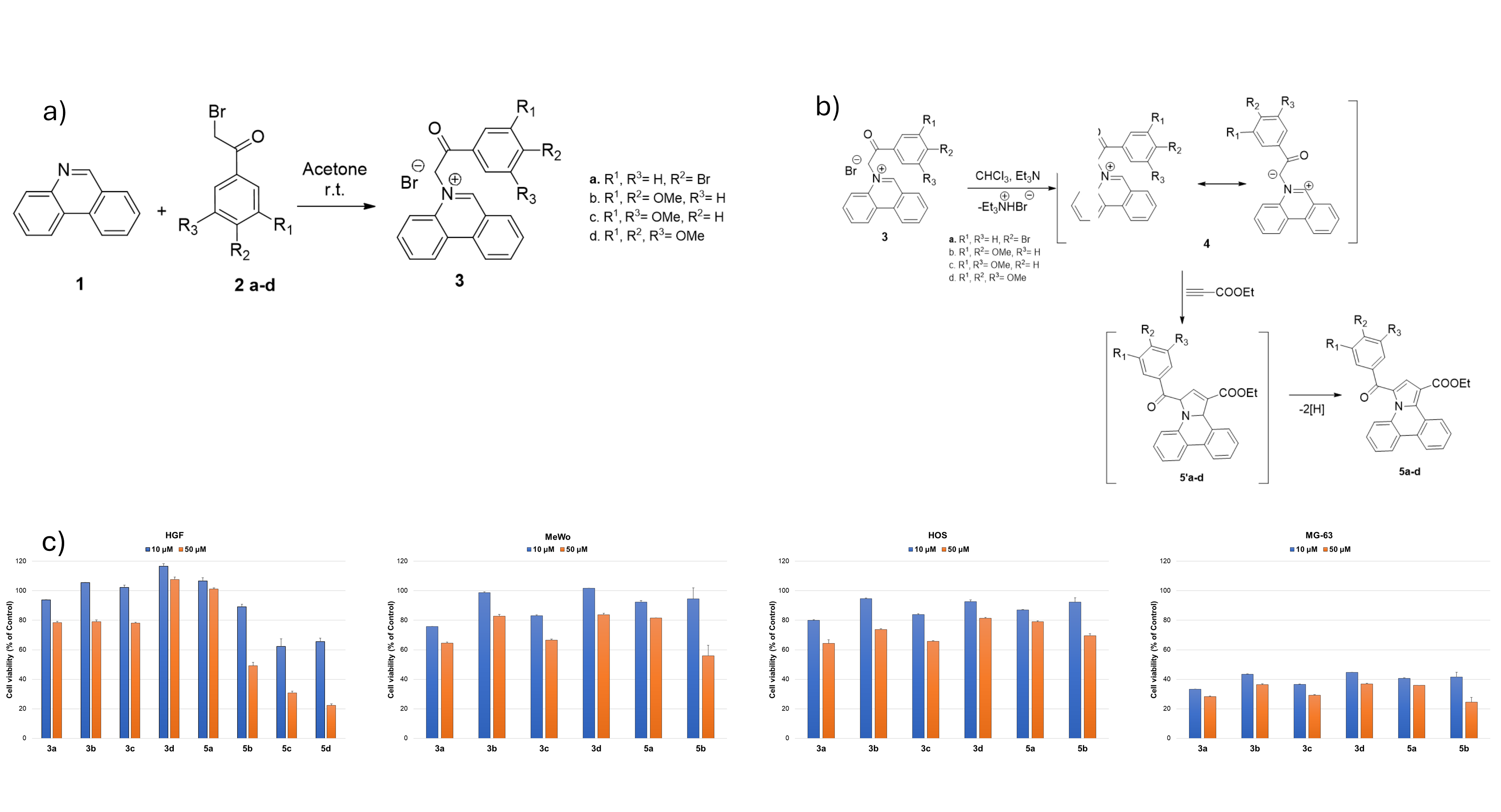
Fig. 5. (a) Reaction pathway to monoquaternary salts 3a–d. (b) Reaction pathway to compounds 5a–d. (c) Cell viability of normal fibroblasts (HGF) incubated with the compounds (10 and 50 µM) for 24 h; cytotoxicity of selected compounds (3a–d, 5a and 5b) at 10 and 50 µM against malignant melanoma (MeWo) and human osteosarcoma cell lines (HOS and MG-63) after 24 h incubation.
Another research direction involved the synthesis of silver nanoparticles using the pure flavonoids naringin (NG) and naringenin (NGN). The resulting nanoparticles exhibited significant antioxidant and antimicrobial properties. ESR spectroscopy protocols were developed to evaluate antioxidant capacity, and results indicated that, upon functionalization as AgNPs, these flavonoids not only retain but enhance their antioxidant activity—likely due to synergistic interactions between flavonoid cores and silver ions (Fig. 6).

Fig. 6. In vitro antimicrobial activity of the nanoparticles: inhibition of microbial growth (a. S. aureus, b. E. coli, c. E. faecalis, d. K. pneumoniae, e. C. albicans, and f. C. glabrata) expressed as percentage of viable cells vs. incubation time. Statistical significance: p < 0.05 (10 min – Lev vs. AgNGN for E. faecalis; AgNG vs. AgNGN for C. albicans; Nys vs. AgNG and AgNG vs. AgNGN for C. glabrata; 20 min – AgNG vs. AgNGN for C. albicans; 40 min – AgNG vs. AgNGN for S. aureus; 2 h – Lev vs. AgNG, AgNG vs. AgNGN for S. aureus); ** p < 0.01 (10 min – Lev vs. AgNG, AgNG vs. AgNGN for K. pneumoniae, AgNG vs. AgNGN for E. coli). Lev – levofloxacin; Nys – nystatin; min – minutes.
Another study focused on obtaining SERS substrates based on ZnO thin films directly decorated with gold nanoparticles via photoreduction—a method that eliminates the need for organic binding agents or surfactants (Fig. 7).

Fig. 7. Structural and morphological analysis: (a) Raman spectra of samples obtained under different experimental conditions; (b) XRD structural analysis; (c) SEM analysis of the surface microstructure of ZnO films obtained through pulsed laser deposition (PLD) combined with laser-induced recrystallization.
Additional investigations were conducted on exopolysaccharides with properties suitable for cryogel formation, as well as on ozonated sunflower oils, which were characterized to evaluate their in vitro antioxidant activity.
A separate study examined the free radicals generated upon UV irradiation of urocanic acid and their role in initiating skin carcinogenesis. Based on experimental data (MS, UV-Vis), ROS fragments were generated and analyzed computationally using DFT/TD-DFT methods.
Furthermore, nitrogen adsorption–desorption experiments were performed on a series of porous compounds, which exhibited permanent porosity, with BET surface areas between 2.7 and 8.4 m²/g and total pore volumes between 0.003 and 0.012 cm³/g.
In parallel, studies were initiated on the synthesis of coordination compounds based on 4,4'-diamino-2,2'-stilbenedisulfonic acid, and their structures were elucidated by single-crystal X-ray diffraction.
The results obtained during this stage were disseminated through 12 scientific articles published or accepted for publication and through participation in 4 international scientific events, confirming the impact and relevance of the research activities undertaken. |